

Translating an architectural vision into a physical product is not merely a matter of aesthetics; it is a problem of engineering and material integrity. When evaluating commercial teak furniture styles, these pieces do not exist in a vacuum, they must integrate seamlessly into a broader interior design scheme while withstanding the constant, brutal load of daily use in hospitality or corporate environments.
Unlike standard mass producing Indonesian teak furniture manufacturers that rely on cosmetic camouflage to hide structural flaws, Naramulya operates as a technical workshop. We approach commercial teak furniture styles not as superficial trends, but as specific engineering challenges. Solid teak (Tectona Grandis) is our baseline. How this material is cut, dried, and joined dictates whether your design vision survives for decades or fails within the first six months.
This technical lookbook breaks down today’s most dominant interior design styles, detailing how our commercial scale facility executes each design specification with uncompromising structural honesty.
In this post:
1. Japandi Style: The Geometry of Structural Honesty
Japandi is not simply a hybrid of Japanese minimalism and Scandinavian hygge; from a woodworking perspective, it is one of the most unforgiving commercial teak furniture styles to execute. A design that eliminates ornamentation means every joint, every line, and every surface is fully exposed.
Technical Execution Specifications:
- Zero Tolerance for Concealment: Without decorative elements to hide defects, the use of cosmetic wood filler is a fatal violation. We rely strictly on rigorous initial grading.
- Precision Joinery: Minimalist silhouettes demand high structural stability. We execute this with precision Mortise & Tenon joints utilizing industrial grade adhesives (2-part epoxy / PU), strictly refusing the use of nail guns that compromise the wood fiber integrity.
- Grain Alignment: We specifically select straight grain heartwood to align with the calm, ordered geometry required by the space.
The Role of Teak Furniture: Indonesian teak is a perfect fit for the Japandi style. Its warm, golden hue provides the hygge coziness, while its clean, straight grain lends itself beautifully to the minimalist forms of Japanese design. A simple Naramulya dining table or a low-profile bed frame can serve as the perfect, grounding centerpiece in a Japandi room, allowing its natural beauty and craftsmanship to shine.
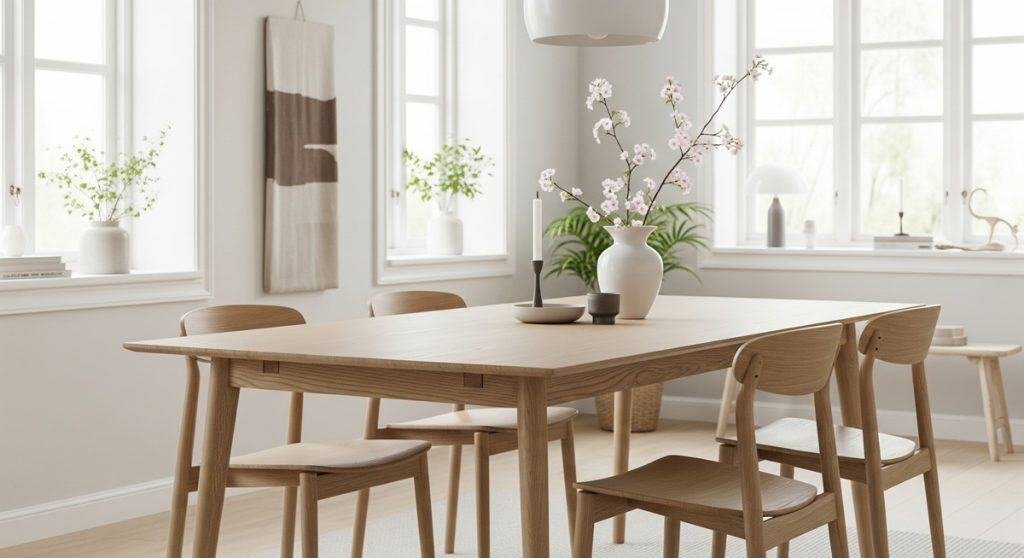
Learn exactly how we eliminate structural weaknesses in minimalist designs in our deep dive into the technical execution of Japandi style furniture.
2. Mid-Century Modern (MCM): Engineering Organic Functionality
Mid-Century Modern is defined by clean lines, slender tapered legs, and organic curves. Technically speaking, distributing dynamic loads across a small cross-section of wood (such as an MCM chair leg) requires maximizing the material’s tensile strength.
Technical Execution Specifications:
- Thermal Shock Prevention: Slender legs are highly susceptible to warping or cracking if the moisture ratio fluctuates. We enforce a strictly controlled Moisture Content (MC) of 8–12% (Kiln-Dried), with a mandatory pre-kiln air drying process to prevent thermal shock to the cellular structure of the wood.
- Load-Bearing Angles: MCM designs often feature sharply angled backrests. This is a matter of load distribution requiring precise Dovetail joinery to prevent structural failure under pressure.
- Material Density: Teak is the absolute material for MCM because its natural density can support thin structural forms without losing stiffness.
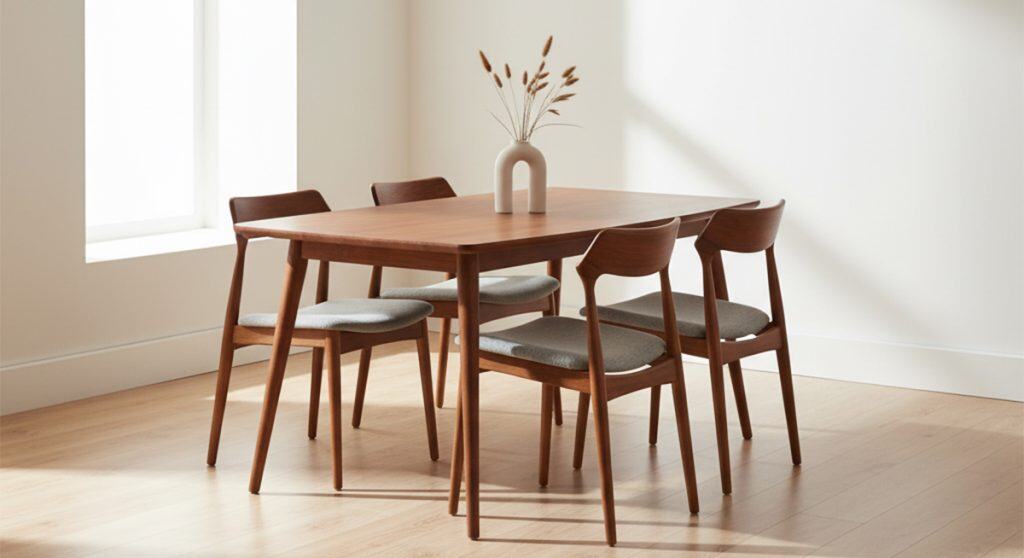
For a detailed exploration of this iconic aesthetic, including key pieces and a manufacturer’s insight into its construction, read our complete guide: Mid-Century Modern, Reimagined
3. Modern Minimalist: The Architectural Statement Piece
In a space where furniture is reduced to its most essential function, a “statement piece” must possess architectural weight. Modern minimalism emphasizes negative space, meaning the objects within that space must be executed with commercial grade authority.
Technical Execution Specifications:
- Proprietary Internal Grading: For a statement piece, material transparency is paramount. We separate Grade A (Perhutani/Heartwood) for maximum density and weather resistance, Grade B (Community Plantation/Heartwood) for interior applications with dynamic grain, and completely reject Grade C (Sapwood) for primary structural components.
- Monolithic Stability: Large minimalist tables or sideboards require wide wooden panels. Strict moisture control (MC 8-12%) is the only way to prevent shrinkage and seasonal movement across such expansive surface areas.
The Role of Teak Furniture: In a minimalist interior, a piece of solid teak furniture can act as a “functional sculpture.” Its natural warmth and organic grain provide a necessary and powerful contrast to the clean lines and neutral colors of the surrounding space, preventing it from feeling impersonal.
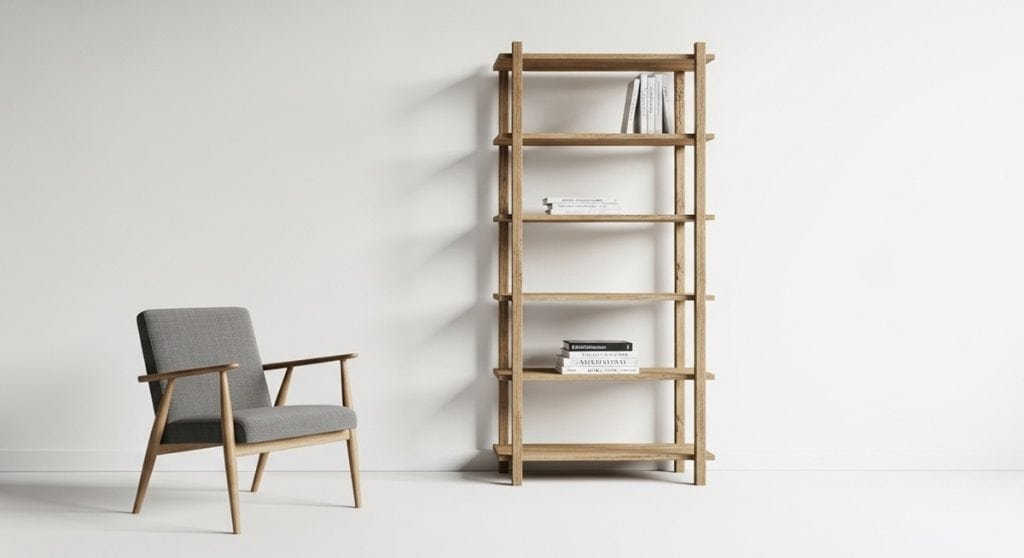
Learn how to anchor your space by reading our Guide to Modern Minimalist Interiors and the Power of a Statement Piece.
4. Mixed-Material Modern: Managing Coefficient of Friction
Integrating metal or stone makes this one of the most dynamic commercial teak furniture styles available, but it introduces a complex engineering challenge. Each material responds differently to ambient temperature and humidity.
Technical Execution Specifications:
- Differential Movement Allowance: Teak wood expands and contracts; steel and stone do not. Our construction accounts for these varying expansion coefficients. We engineer high-tolerance connection points (slotted attachments) between the wood and metal frames, allowing the wood to move freely without fracturing the joint or shearing the bolts.
- Adhesive Compatibility: Bonding non-porous materials (metal/stone) to porous teak requires industrial-grade reactive adhesives, far beyond standard PVAc wood glue.
The Role of Teak Furniture: Teak serves as the perfect grounding element in mixed-material design. Its warm, stable presence provides a beautiful counterpoint to other materials. As manufacturers, we can engineer pieces that feature:
- Teak tabletops on sleek, powder coated steel bases.
- Solid teak frames with luxurious marble or granite tops.
- Dining chairs that combine a solid teak structure with modern, upholstered seats.
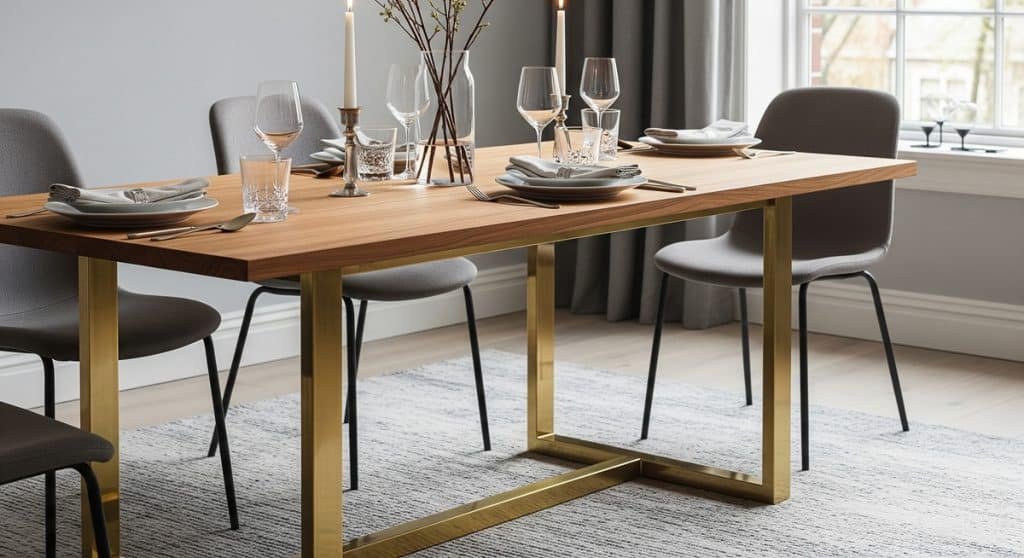
Explore the possibilities and technical considerations in our Guide to Pairing Teak with Metal, Stone, and Fabric.
5. Biophilic Design: Stabilizing Raw Nature
Bringing nature indoors (biophilic design) frequently involves utilizing live edge wood or organic forms. The core challenge: raw, unstabilized organic wood will continue to “live” and move, particularly inside commercial spaces with aggressive HVAC systems.
Technical Execution Specifications:
- Deep-Core Drying: Thick, organic slabs require highly calibrated, exceptionally slow drying profiles. Forcing a rapid kiln dry will cause honeycombing (internal fracturing). Our pre-kiln air drying protocol stabilizes the core before the final kiln phase (MC 8-12%).
- Tactile Finishing: Instead of sealing the wood pores under a thick layer of polyurethane that kills its natural texture, we utilize penetrating oils or advanced water-based coatings. This protects the teak from the inside out while maintaining the pure tactile interaction between the user and the material.
The Role of Teak Furniture: As a core natural material, teak is essential to a successful biophilic interior. Its authentic grain, solid feel, and warm tones provide a direct, tangible connection to the natural world. A live edge table brings the raw form of the tree indoors, while the simple presence of beautifully finished solid wood furniture can ground a space and provide a necessary contrast to the hard surfaces of a modern building.
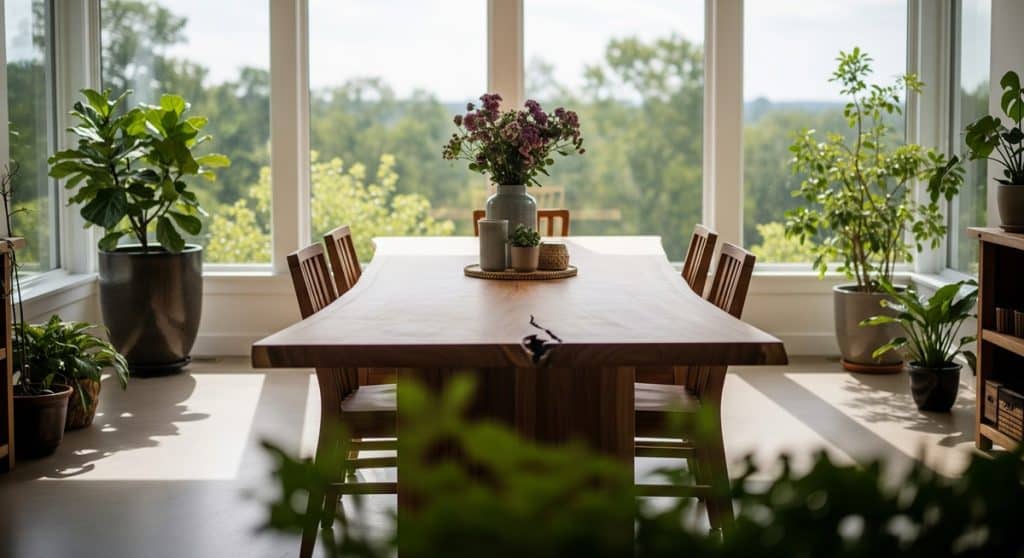
Discover the core principles of this important trend in our Guide to Biophilic Design.
6. The Language of Color: Interaction of Chemistry and Grain
Color theory in teak furniture is not about painting the wood; it is about understanding the chemical reaction between the finishing agents and the natural tannins and oils inherent in Tectona Grandis.
Technical Execution Specifications:
- Heartwood Reactivity: High-grade teak is rich in natural oils and silica. These natural oils repel many chemical solvents. We formulate our coatings to ensure full penetration into the Heartwood, ensuring the finish will not peel or flake under commercial use.
- Tonal Consistency: Achieving a uniform golden-brown tone across a bulk order requires rigorous initial grading, not relying on heavy, opaque stains that obscure the wood’s true character.
The Role of Teak Furniture: Teak’s warm undertones can be paired with a variety of palettes. It can be complemented by serene neutrals and earthy greens for a calming effect, or it can be contrasted with deep, moody tones like charcoal grey or navy blue to make the wood’s golden color “pop.”
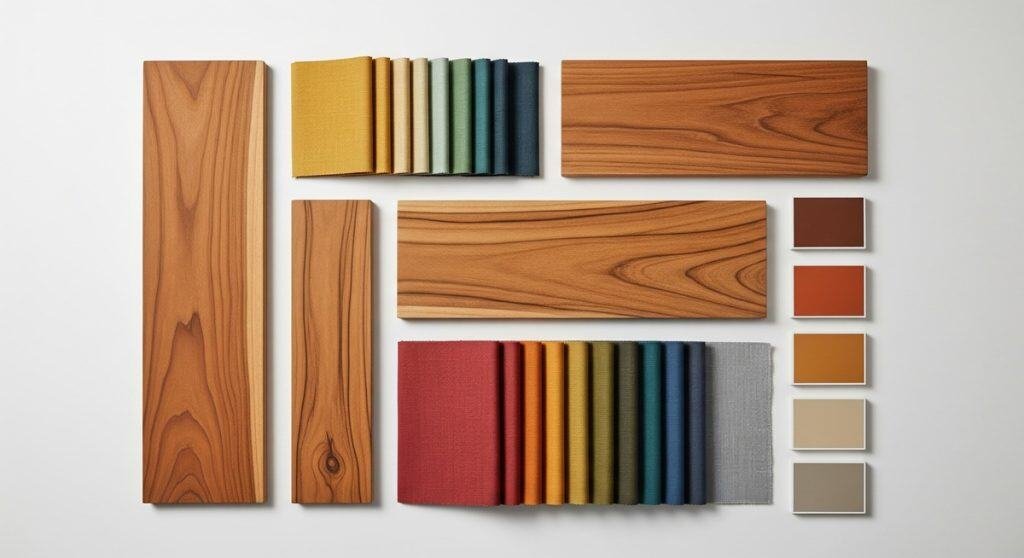
For detailed inspiration, see our guide to 5 Professional Color Palettes That Complement Natural Teak.
7. Modern Tropical: Engineering for Extreme Environmental Transitions
Resort architecture blurs the line between indoor and outdoor spaces. For commercial-grade furniture, this means continuous exposure to aggressive UV radiation, saline air, and extreme humidity fluctuations.
Technical Execution Specifications:
- Kinetic Slatted Design: Solid wood expands when exposed to tropical humidity. We engineer slatted backrests and seats with precise spacing tolerances, allowing the Tectona Grandis to breathe and move without tearing the structural frame apart.
- Outdoor-Grade Adhesives: Standard PVAc glues degrade under high moisture and UV exposure. We specify marine-grade, 2-part epoxy for all structural joints in our tropical collections.
- Permeable Finishes: Film building finishes will eventually crack and peel in tropical environments. We utilize deep-penetrating UV oils that protect the wood fiber internally while allowing for easy commercial maintenance.
Review our execution of these transitionary pieces in our technical manufacturing of the Windu Sari Villa project.
8. Wabi-Sabi: Stabilizing Engineered Imperfection
The Wabi-Sabi philosophy embraces natural imperfection, often highlighting knots, irregular grain, or natural checking (cracks). However, in a commercial scale facility, there is a strict boundary between an “aesthetic imperfection” and a “structural failure.”
Technical Execution Specifications:
- Crack Stabilization: A natural crack in a solid teak slab will continue to split if left untreated under dynamic loads. We arrest this kinetic movement using precision-routed butterfly joints (bowties) or structural epoxy injections, turning a potential failure point into a stabilized design feature.
- Controlled Degradation: We artificially weather the wood using reactive chemical treatments rather than destructive mechanical gouging, ensuring the cellular structure of the teak remains uncompromised.
Understand the boundary between flaw and feature in our analysis of the Wabi-Sabi furniture philosophy.
9. Heritage & Antique Reprohduction: Scaling Traditional Geometry
Replicating colonial or traditional heritage styles does not mean creating fragile museum pieces. It requires taking the traditional, proven joinery geometries of the past and executing them with the precision of a modern technical workshop to meet commercial volume demands.
Technical Execution Specifications:
- Machined Mortise & Tenon: Traditional hand-cut joinery is structurally sound but lacks consistency at scale. We utilize modern routing technology to replicate traditional deep-set Mortise & Tenon joints with zero-tolerance precision across FCL bulk orders.
- Authentic Patination: Rather than spraying artificial “antique” glazes that sit on top of the wood, our finishing protocol involves layered, hand-rubbed patination that mimics decades of natural oxidation without compromising the protective topcoat.
Explore our historical specifications in The Heritage Archive of antique reproduction furniture.
Conclusion: Execution Meets Capacity
Mastering these commercial teak furniture styles requires more than a basic understanding of design; it demands precise technical execution. As a technical workshop based in Jepara, Naramulya understands that B2B clients, architects, and procurement managers require absolute certainty—both in material specification and delivery capacity.
Our commercial scale facility is built specifically to manufacture to these exacting specifications. We possess the measured capacity to execute 20ft and 40ft containers (FCL) monthly, while deliberately maintaining an agile production setup to accommodate boutique, low-MOQ projects. You can review how we apply this structural precision in real-world applications, such as our commercial furniture execution for the Ketewel Beach Villas project.
We do not sell aesthetic magic. We execute your design with calculated engineering, honest materials, and reliable scalability.