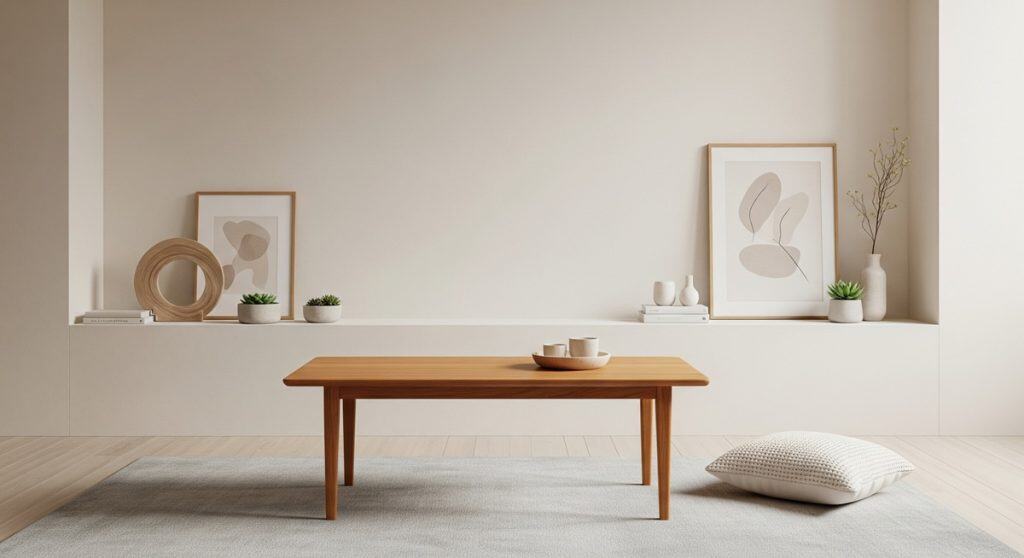
In the commercial interior sector, the demand for japandi style furniture is often misunderstood as a simple aesthetic trend. For architects and procurement managers, however, achieving this minimalist look at a commercial scale presents a strict engineering challenge.
Merging the rustic authenticity of Japanese wabi-sabi with the highly functional, clean lines of Danish hygge requires absolute structural honesty. Without heavy ornamentation or thick moldings to hide manufacturing flaws, the integrity of the raw material and the precision of the joinery are fully exposed.
At Naramulya, our technical workshop approaches Japandi not as an aesthetic, but as a rigid set of dimensional and material standards. Here is how we engineer this demanding style for our B2B technical partners.
1. Material Transparency: The Foundation of Minimalist Forms
Japandi design dictates large, uninterrupted flat planes and slender structural profiles. To achieve this without compromising load-bearing capacity, material selection must be uncompromising.
- Tectona Grandis Execution: We utilize strictly legally-sourced Tectona Grandis (Indonesian Teak). Its dense grain structure provides the tensile strength required for the minimalist silhouettes typical of Japandi seating and case goods.
- Strict Grading Standards: For highly visible, structural planes (like a minimalist dining table top), we specify Grade A (heartwood). However, for budget optimization on large-scale commercial rollouts, we honestly present Grade B and Grade C options for secondary, internal framework elements.
- Zero-Filler Policy: Because Japandi celebrates the natural state of the wood, we enforce a strict zero-filler policy. We do not use cosmetic synthetic putties to hide knots or structural defects. The wood you see is the wood supporting the load.
2. Moisture Control for Unforgiving Silhouettes
When a design features long, clean lines and unadorned surfaces, even a millimeter of timber warping becomes glaringly obvious. Proper moisture control is the only defense against dimensional instability.
- Pre-Kiln Air-Drying: Before entering the kilns, our teak undergoes a mandatory ambient air-drying phase. This prevents cellular thermal shock, which can cause surface checking on the wide, flat panels often found in Japandi sideboards and beds.
- Scientific MC Stabilization: The lumber is then processed in our computerized kilns to bring the internal Moisture Content (MC) down to a stabilized 8–12%. This ensures that a Japandi console table manufactured in our facility remains dimensionally inert, whether placed in a dry Scandinavian high-rise or a humid Asian resort.
3. Structural Honesty and Advanced Joinery
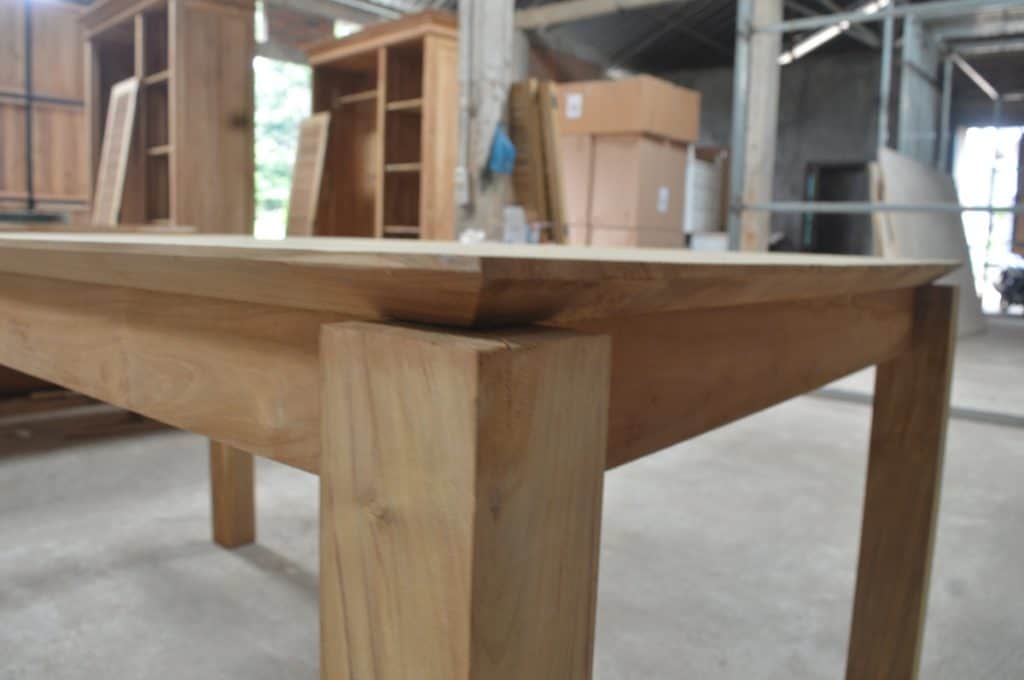
Japandi style furniture inherently rejects the use of mechanical hardware as a primary structural support. The strength of the piece must come from the wood-to-wood connections.
Fastener Protocol: Mechanical fasteners (screws, steel brackets) are strictly limited to non-structural elements or specific knock-down (KD) hardware requirements. They are never utilized to compensate for poorly executed wood joinery.
Exposed, High-Tension Joinery: Our commercial-scale facility excels in the exact execution of advanced joinery. We frequently utilize deep Mortise & Tenon, precise Finger Joints, and high-tension Japanese or Scandinavian through-tenon construction. In Japandi design, these joints are often left visible, acting as both the structural anchor and the visual focal point.
Industrial-Grade Adhesion: All structural joints are permanently bonded using industrial-grade 2-part epoxy or high-performance Polyurethane (PU) adhesives to withstand heavy commercial use.
4. Scalable Execution for Commercial Projects
Whether you are specifying clean, functional seating for a boutique hotel lobby or minimal, wabi-sabi inspired case goods for a luxury residential development, execution must be scalable.
Our logistics team guarantees B2B capacity, managing everything from bespoke architectural orders to highly coordinated, full 20ft and 40ft container (FCL) dispatch. Every piece is engineered to arrive with the same tight tolerances it had on our assembly floor.
Japandi design requires a technical partner who understands the engineering behind the minimalism. To see how this aesthetic fits into our wider production capabilities, explore our comprehensive guide to commercial teak furniture styles. For project inquiries and CAD specification reviews, contact our technical team today.
Let’s Build Your Japandi Vision
If you are an architect, designer, or homeowner looking to create a space with the timeless appeal of Japandi design, we are ready to help. We can manufacture custom teak pieces to your exact specifications, ensuring the perfect fit for your project.