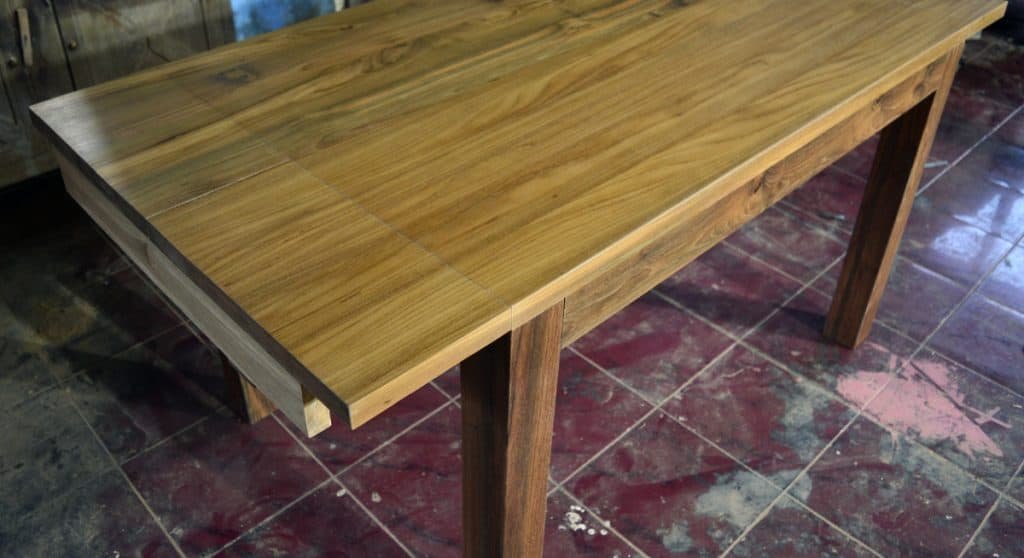
Unlike standard retail suppliers who market reclaimed teak purely as an “eco-friendly” or “rustic” aesthetic trend, our commercial scale facility views timber selection as a strict engineering variable. The decision between reclaimed teak vs plantation teak completely alters the fabrication workflow, tooling calculations, and final yield rates.
To the untrained eye, both materials yield a durable final product. However, from a structural and operational standpoint, they behave as two entirely different mediums. This guide strips away the marketing jargon to provide a hard, objective analysis of reclaimed teak vs plantation teak, designed specifically for B2B specifiers and lead engineers.
Section 1: The Engineering Profile of Plantation Teak
Plantation teak is cultivated timber, systematically managed and harvested primarily by Perum Perhutani in Indonesia on a 20 to 30-year cycle. It is the baseline material for modern, high precision woodworking.
Technical Characteristics
- Density and Grain Uniformity: Because the trees grow in controlled environments, the resulting cellular structure is highly consistent. This uniformity allows our engineers to standardize CNC feed rates and blade RPMs without fear of sudden density spikes.
- Yield Optimization: Plantation timber provides a highly predictable yield. The boards are milled clean, meaning less raw material is lost to defects. This predictability is critical when calculating raw material volume for large scale 20ft or 40ft FCL hospitality orders.
- Machinability: The predictable grain structure ensures clean cuts for structural joinery. Cutting a precise mortise and tenon joint is straightforward, allowing for tolerances of 0.15mm to 0.20mm without the need for cosmetic wood fillers to hide gaps.
Operational Verdict: Plantation teak is the mandatory choice when executing multi room hospitality projects or minimalist designs that demand absolute dimensional consistency, zero visual defects, and rapid, scalable fabrication.
Section 2: The Fabrication Reality of Reclaimed Teak
Reclaimed teak is timber salvaged from demolished structures (such as traditional Javanese Joglos, railway sleepers, or colonial era warehouses). While structurally superior in some aspects, it is an absolute nightmare to machine.
Technical Characteristics
- Extreme Dimensional Stability: Having been subjected to decades of atmospheric expansion and contraction, reclaimed teak is effectively “dead” wood. The internal stress has been completely released over a half-century. It offers unmatched resistance to warping or twisting.
- Crystallization and Tooling Damage: Over decades, the natural silica and resins within the teak harden and crystallize. Combined with its old growth density, this material instantly blunts standard High Speed Steel (HSS) and severely degrades Tungsten Carbide router bits.
- The Contamination Factor: Reclaimed wood is riddled with shrapnel snapped iron nails, bolts, and embedded rocks. Every single plank must be meticulously scanned with industrial metal detectors. A single missed nail will shatter a CNC bit, halting production and posing a safety hazard.
- Adhesion Resistance: Decades of surface oxidation and trapped dirt mean standard PVA glues will fail. To ensure structural integrity, joints in reclaimed teak must be secured using heavy-duty 2 part epoxy or PU adhesives that can penetrate the oxidized fibers.
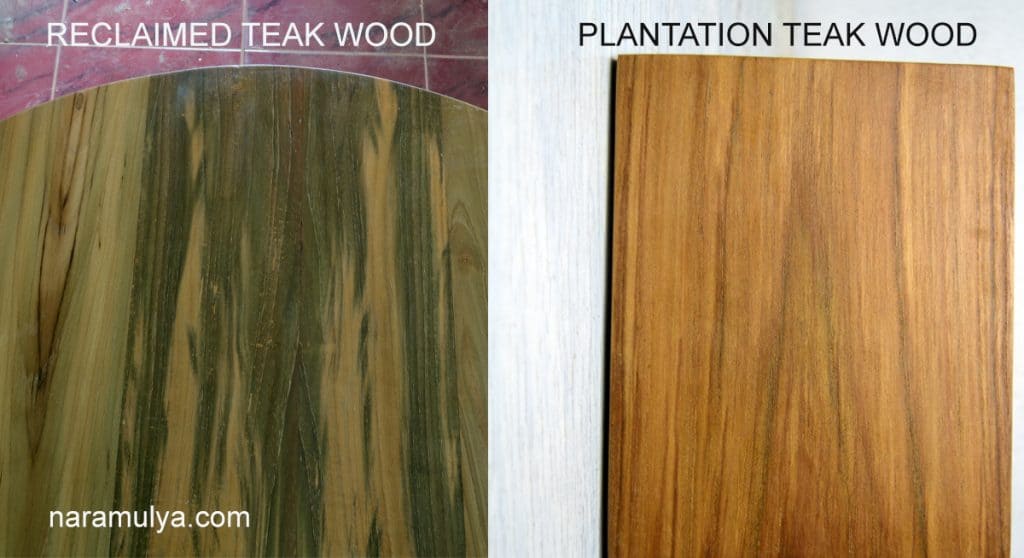
Operational Verdict: Reclaimed teak offers unparalleled mechanical stability but suffers from a massive waste factor (often losing 30-40% of its volume during the cleaning and milling phase). It is strictly reserved for high value, low-MOQ boutique projects where visual variation (nail holes, oxidized patches) is an accepted architectural specification.
Section 3: The Moisture Content Equalization Rule
There is a dangerous myth in the industry that reclaimed teak, because it is old, does not need to be kiln-dried. This is structurally false.
Reclaimed timber salvaged from outdoor environments in tropical climates will sit at an Equilibrium Moisture Content (EMC) of 15% to 18%. If fabricated at this MC and shipped to a climate-controlled hotel lobby in Europe or North America, the wood will still shrink, tearing apart internal joinery.
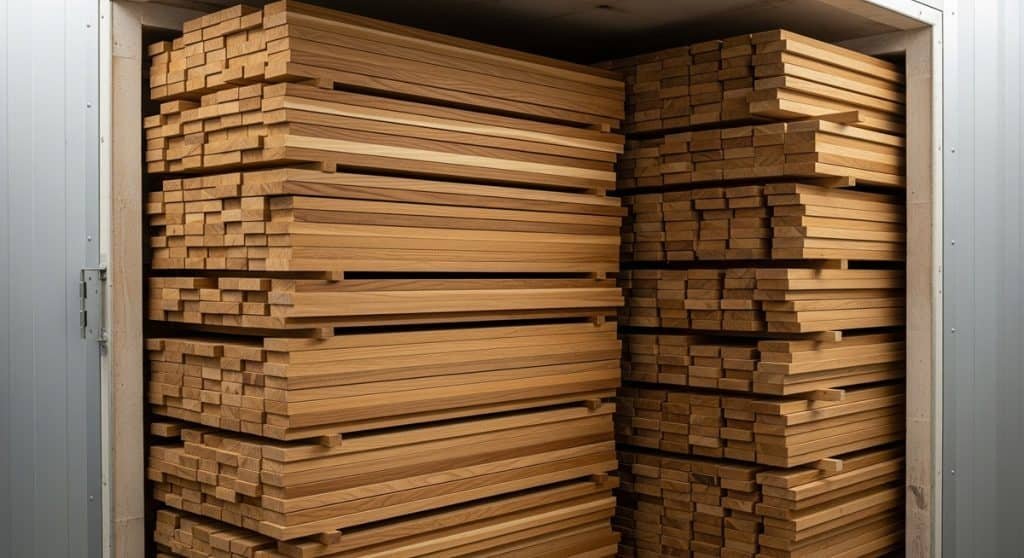
Whether we are processing freshly milled plantation timber governed by our proprietary internal grading standard or century old reclaimed beams, all material must undergo equalization. Every plank is subjected to our thermodynamic kiln-drying protocol until the core registers a strict 8–12% MC.
Section 4: Technical Comparison Matrix for Specifiers
When determining the material for your procurement pipeline, rely on these operational metrics:
| Specification Metric | Plantation Teak (Perhutani Grade A/B) | Reclaimed Teak (Salvaged Old-Growth) |
|---|---|---|
| Volumetric Yield | High (80-90% usable material) | Low (50-60% usable due to defects/nails) |
| Machining Tolerance | Excellent (Predictable CNC execution) | Poor (Requires manual intervention, damages tooling) |
| Visual Consistency | High (Uniform color and grain mapping) | Zero (Severe variation, nail holes, staining) |
| Dimensional Stability | High (Relies on strict 8-12% KD process) | Extreme (Naturally seasoned + 8-12% KD process) |
| Scalability (FCL) | Highly Scalable | Extremely limited by raw material availability |
Section 5: Industry Warning: Detecting Counterfeit Reclaimed Teak
The high demand and elevated price point for reclaimed timber have spawned a massive counterfeit market in the furniture export industry. Many large scale suppliers actively deceive B2B buyers by taking freshly milled plantation teak and artificially aging it. They utilize wire brushes to gouge the soft grain, chains to simulate physical damage, and heavy chemical stains to mimic decades of oxidation.
To the untrained eye, it looks like an antique. But as technical fabricators, we know that while you can fake surface damage, you cannot fake cellular biology.
The single most reliable metric for authenticating reclaimed teak is Growth Ring Density (Tight Grain):
- The Fake (Fast-Grown Timber): Young plantation trees grow rapidly in open sunlight. This rapid expansion creates wide spacing between the annual growth rings. If a “reclaimed” beam has wide, loose grain patterns, it is a modern counterfeit.
- The Authentic (Old-Growth Timber): True reclaimed teak was harvested a century ago from virgin, old-growth forests. These trees grew extremely slowly under a dense, highly competitive canopy. This slow growth resulted in incredibly tight, compressed growth rings.
Color can be replicated in a finishing booth in hours. True old-growth density takes a century to form. When auditing a supplier, ignore the “rustic” surface finish and look directly at the grain structure. If the growth rings are wide, you are paying a heavy premium for distressed young wood.
Conclusion: Selecting the Right Structural Medium
The debate between reclaimed teak vs. plantation teak is not an emotional choice about history or sustainability; it is a mathematical calculation regarding project scale, visual requirements, and fabrication constraints.
If your project requires 500 identical chairs with precise tolerances, plantation teak is the only viable path. If your project calls for massive, monolithic statement tables where extreme density and visual irregularity are required, authentic reclaimed teak is the superior medium.
At Naramulya, our technical workshop is equipped to execute both, provided the material aligns with the engineering reality of the project and passes our strict authentication protocols.