Unlike standard mass producing Indonesian teak furniture suppliers who force freshly milled, saturated timber straight into a high temperature oven to artificially rush lead times, we treat moisture extraction as a strict mechanical science.
Rushing the drying process destroys the cellular structure of Tectona Grandis (Teak). At Naramulya’s commercial scale facility, achieving a strict 8–12% Moisture Content (MC) is not a suggestion; it is the baseline engineering requirement for structural stability.
This guide breaks down the thermodynamics of wood drying, debunks common industry shortcuts, and explains why our rigorous, multi phase kiln-drying protocol is the ultimate risk mitigation for B2B procurement.
Section 1: The Cellular Mechanics of Teak and EMC
To engineer commercial grade furniture, one must understand how wood retains moisture. Water exists in freshly felled timber in two distinct forms:
- Free Water: Liquid water filling the microscopic cell cavities (lumens).
- Bound Water: Moisture chemically trapped within the cell walls themselves.
The goal of our technical workshop is to bring the wood to its Equilibrium Moisture Content (EMC) the exact point where the wood neither absorbs nor releases moisture into its surrounding environment.
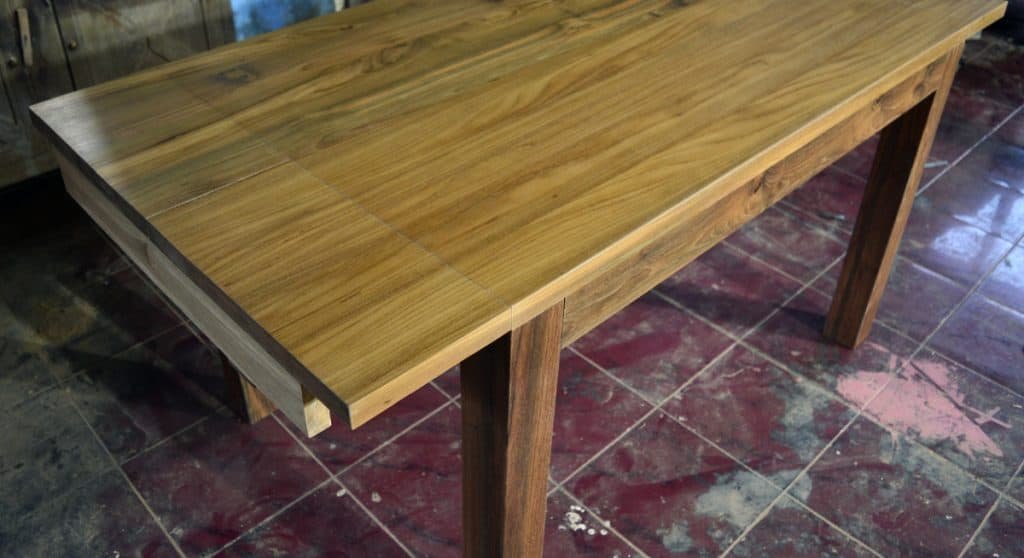
A teak table placed in a dry, centrally heated hotel lobby in Dubai might settle at an EMC of 6%. The same table in a coastal resort in Bali might settle at 14%. If a supplier builds a table using wood at 18% MC and ships it to an 8% EMC environment, the cellular walls will shrink. This shrinkage exerts massive kinetic stress, resulting in cracked table tops, warped casework, and the total failure of internal joinery.
Understanding Equilibrium Moisture Content (EMC)
Wood will always try to reach a state of balance with the humidity of its surrounding environment. This balance point is its Equilibrium Moisture Content (EMC). A piece of teak furniture in a dry, centrally heated home in Munich might settle at an EMC of 8%. The same piece in a humid, coastal home in Singapore could have an EMC of 14%.
If furniture is built from wood with a moisture content of 15% and placed in an 8% EMC environment, it will shrink, causing stress on joints and potentially cracking the wood itself. This is why our process of kiln drying for furniture is not about getting the wood as dry as possible; it’s about hitting the “sweet spot” the global average for indoor environments, which is 8-12% MC. This ensures our products are stable no matter where in the world they find their home.
Section 2: The Naramulya Protocol: Debunking the “Kiln-Only” Myth
Many mass-market suppliers boast about “100% Kiln-Dried” wood, hiding the fact that pushing saturated wood directly into a hot kiln causes Thermal Shock and Case Hardening. When heated too fast, the outer shell of the timber dries and shrinks rapidly, while the wet core remains swollen. This traps the moisture inside, causing the core to literally tear itself apart (a defect known as honeycombing).
To prevent this, Naramulya enforces a strict, multi-phase drying protocol regardless of whether we are processing our proprietary Grade A or Grade B Indonesian Teak.
Phase 1: Mandatory Air-Drying (Pre-Kiln)
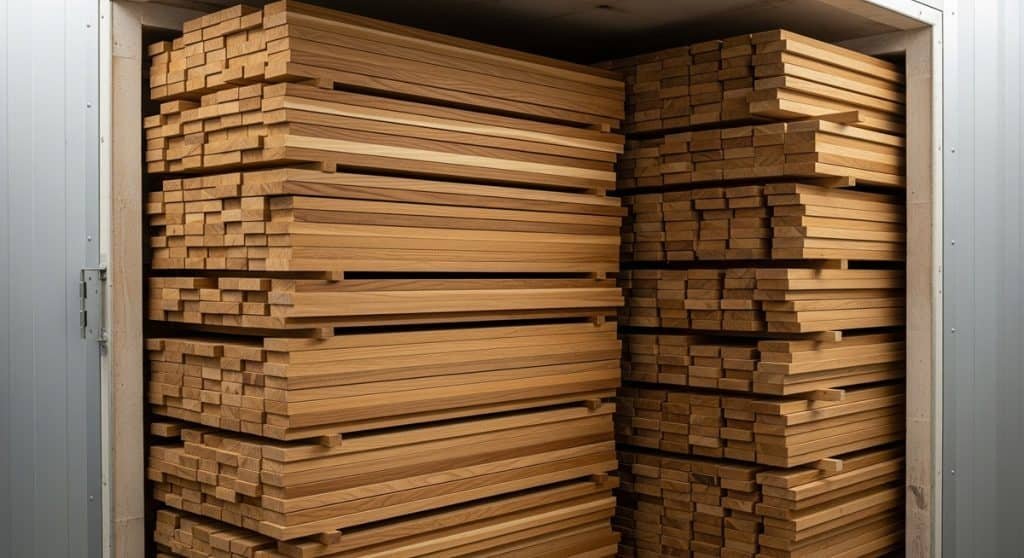
We never bypass the ambient air drying phase. Timber is meticulously stacked using uniform wooden spacers (stickers) in covered, highly ventilated holding yards.
- The Objective: To safely and naturally evaporate the Free Water without inducing thermal stress.
- The Metric: The wood remains in this phase for weeks or months until its internal MC drops safely to the local Jepara EMC (approximately 15-18%). Only then is it structurally ready for the kiln.
Phase 2: Sensor Monitored Kiln Extraction
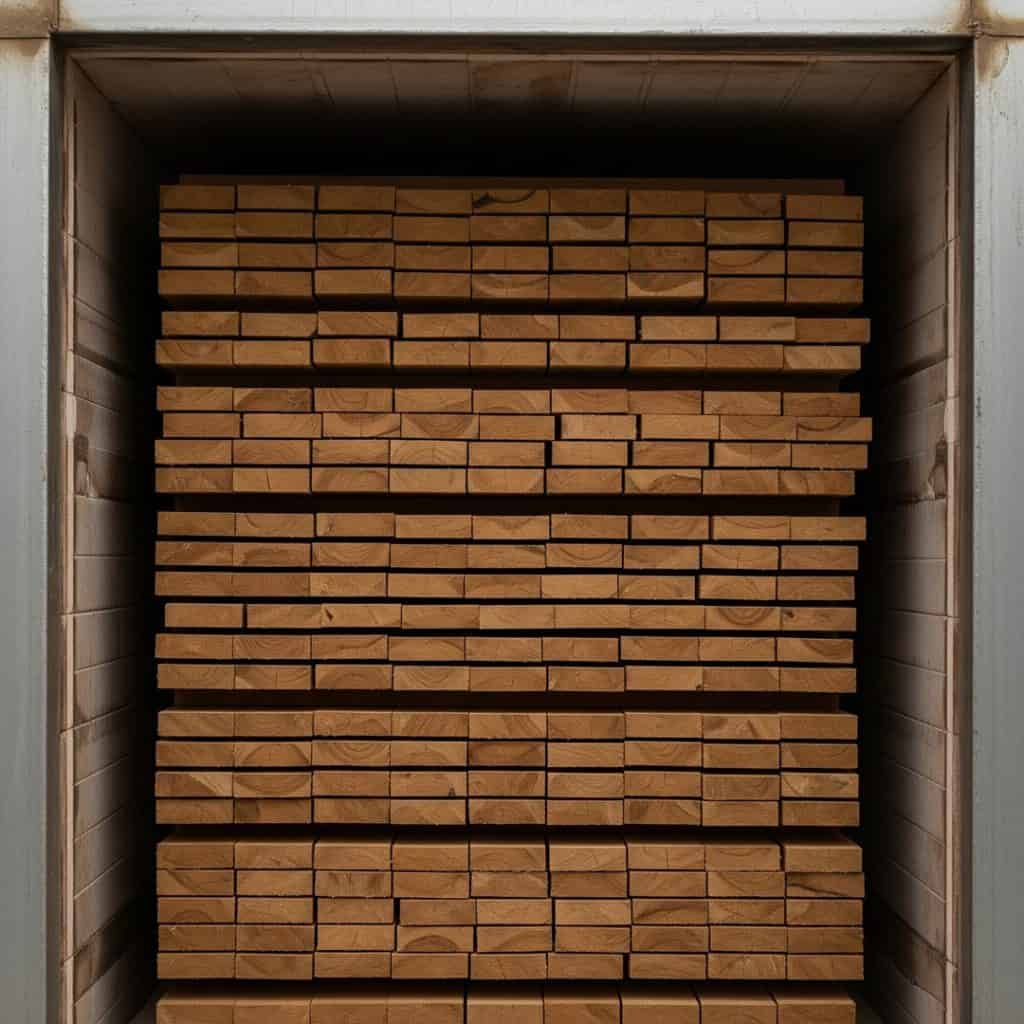
Once the free water is gone, the timber is loaded into our insulated kilns to tackle the stubborn Bound Water.
- The Execution: We operate on strict drying schedules governed by real-time telemetry rather than automated presets. Electronic probes are embedded directly into the core of the thickest timber batches to display internal MC, ambient temperature, humidity, and fan speed. Using this live data, our experienced kiln operators manually modulate the variables. This hands-on calibration ensures the extraction rate responds accurately to the specific cellular resistance of each batch, preventing the drying errors common in fully automated mass-production facilities.
- The Target: We systematically coax the moisture out of the cell walls until the entire stack reaches the strict 8-12% MC global standard for indoor commercial environments.
Phase 3: Steam Conditioning and Equalization
This is the critical final step that inferior suppliers skip to save fuel costs. At the end of the kiln cycle, we briefly reintroduce precise bursts of steam into the chamber.
- The Purpose: The drying process creates immense internal tension within the wood fibers. Steam conditioning relaxes the cellular structure, relieving this stress. Without conditioning, the tension remains trapped; the moment our engineers cut the wood on a table saw, it would violently warp.
Section 3: The Financial Ramifications for B2B Procurement
For architects, interior designers, and procurement managers, specifying furniture made from improperly dried wood is a catastrophic financial risk. The initial cost savings of a rushed product are immediately erased by post-installation failures.
- Cost of Replacement: A single warped cabinet door or cracked dining table in a commercial project necessitates expensive remakes, air freight shipping, and installation labor.
- Joinery Failure: As detailed in our engineering guidelines, even the most precise mortise and tenon joints will snap if the surrounding wood shrinks and distorts due to high moisture content.
- Reputational Damage: In the hospitality sector, a failed piece of furniture in a guest room is a direct hit to the brand’s operational excellence.
Conclusion: Engineering Predictability
Wood is inherently unpredictable. Our kiln-drying protocol exists to strip away that unpredictability, turning raw organic material into a stable, mathematically reliable component for structural fabrication.
Our uncompromising stance on moisture control is the foundation of our manufacturing capability. For a deeper understanding of how we integrate this stable material into large-scale hospitality and residential projects, explore our complete resource for B2B clients and project partners.