Unlike standard mass-producing Indonesian teak furniture suppliers that rely on pneumatic nail guns, metal corner brackets, and cosmetic wood fillers to hide sloppy tolerances, we take a purely structural approach. The true lifespan of commercial-grade furniture is not dictated by its surface appearance, but by the mechanical integrity of its internal connections.
At Naramulya, our technical workshop engineers furniture for high-traffic environments. We integrate the proven structural principles of traditional Javanese joinery—historically utilized in interlocking, hardware-free architecture (bongkar pasang)—with modern fabrication standards.
This guide breaks down the mechanics behind the wood-to-wood joinery executed at our commercial-scale facility, explaining why true structural honesty is the only metric that matters for B2B procurement.
Section 1: Core Mechanical Joints in Teak Fabrication
In structural woodworking, every connection must manage specific load vectors. The joints we execute form the core framework of our products. They require precise machining and zero reliance on wood filler to close gaps.
A. The Mortise & Tenon (Sistem Purus): Maximizing Shear Resistance

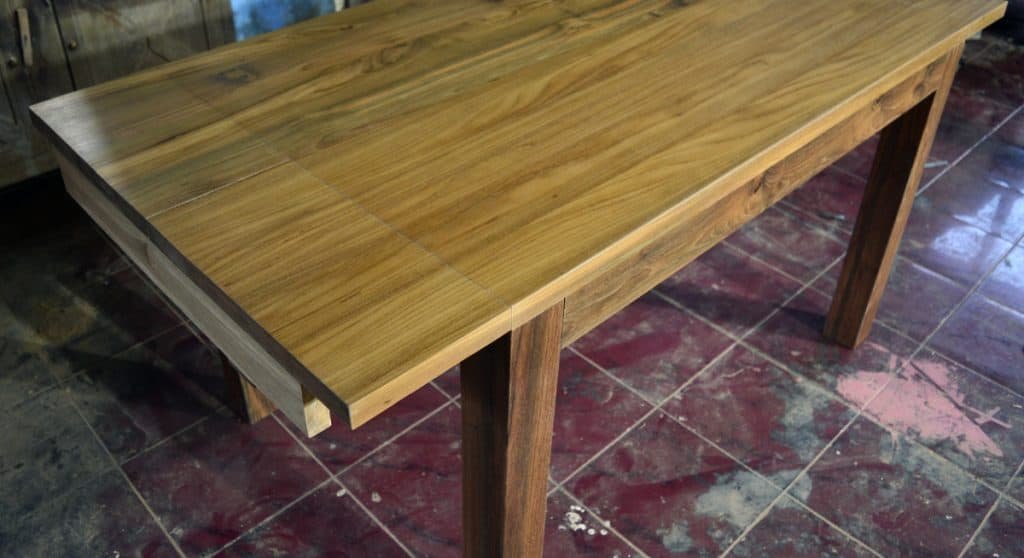
The mortise and tenon is the primary defense against racking forces (lateral shear stress). We engineer this joint for 90-degree intersections, such as connecting structural aprons to table legs.
The physics are straightforward: the tenon (male peg) is machined to exact tolerances to fit the mortise (female slot). This creates a massive surface area for long-grain-to-long-grain glue adhesion.
The Result: A connection where the glue joint is mechanically stronger than the lignin of the surrounding Tectona Grandis (Teak) wood itself.
The Execution: We use heavy-duty router and tenoner machines for absolute geometric precision.
The Adhesion: We strictly utilize industrial 2-part epoxy or Polyurethane (PU) structural adhesives. We do not use standard water-based PVA glues, which are prone to creeping in humid environments.
B. The Dovetail (Sambungan Ekor Burung): Defeating Tensile Stress
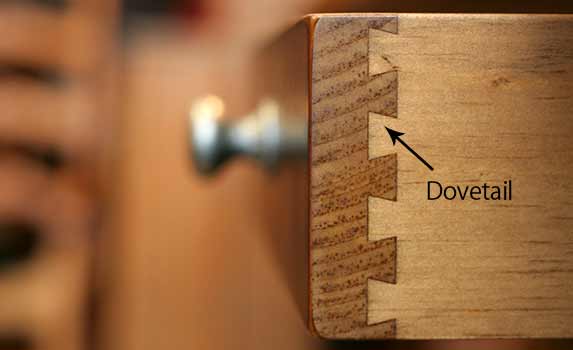
For components subjected to constant pull-out forces (tensile stress), such as commercial drawer boxes or casework carcases, we execute the dovetail joint.
The trapezoidal geometry of the pins and tails means the joint physically cannot be pulled apart on a horizontal axis without fracturing the solid wood.
- Half-Blind Dovetails: Executed on high-end case goods where the mechanical lock is required, but the joint needs to be concealed from the primary viewing angle.
- Through Dovetails: Utilized in heavy-duty drawer construction for maximum structural interlocking.
Section 2: Translating Javanese Architectural Engineering to Furniture

Our approach to load-bearing stability is directly adapted from traditional Javanese timber framing, specifically the Joglo structure. These architectural frames are engineered to withstand massive seismic loads through interlocking joinery, without a single metal fastener.
A. Lateral Bracing (Sunduk & Pengeret)
In a Joglo, the central pillars (soko guru) are locked into a rigid grid using penetrating cross-beams (sunduk) and horizontal braces (pengeret). We scale this engineering down for large furniture formats.
When executing a 3-meter dining table or a massive wardrobe configuration, the core frame is locked together using interlocking stretchers. This prevents the lateral sway that typically destroys standard flat-pack furniture within a year of commercial use.
B. Mechanical Dowel Locking (Paku Kayu)
While industrial PU adhesives provide the chemical bond, we often add a secondary mechanical failsafe known as paku kayu (wooden pegging). Once a mortise and tenon is seated, we drill through the assembly and drive a hardwood dowel through the joint. If the piece ever experiences extreme thermal shock, the wooden dowel physically prevents the tenon from withdrawing.
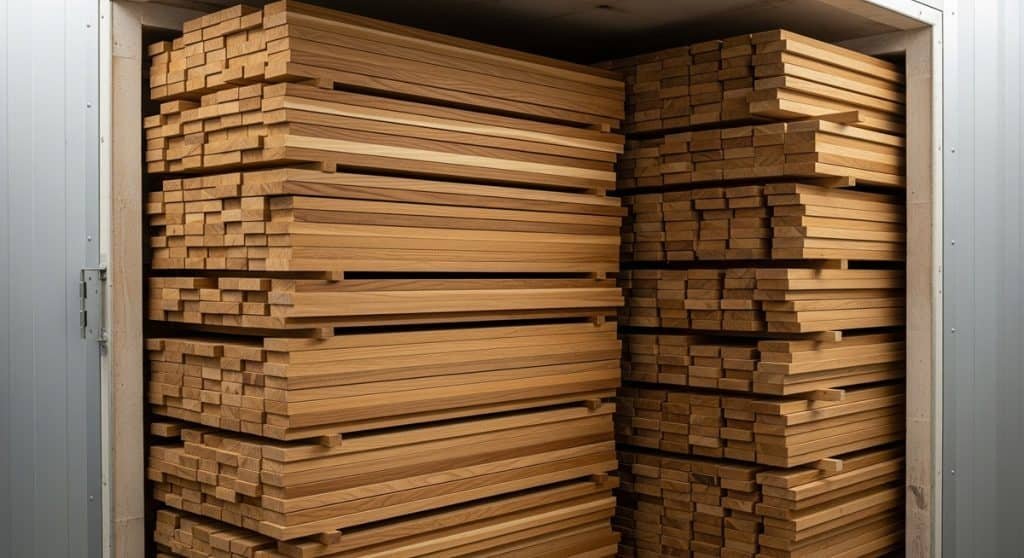
Note on Thermal Shock: To prevent joint failure before it starts, we enforce a strict Moisture Content (MC) standard. Regardless of whether we are using our proprietary grading of Grade A or B Indonesian Teak, all timber undergoes extensive air-drying prior to kiln-drying to a strict 8–12% MC. Wet wood destroys good joinery; our process eliminates that variable.
Section 3: Machining Tolerances and the Physics of the Glue Line
In commercial woodworking, the strength of a joint is heavily dictated by its exact machining tolerances. A mortise and tenon that is forced together too tightly creates a “starved joint”—the mechanical friction scrapes the adhesive out of the cavity during assembly, leaving wood-to-wood contact with zero chemical bond. Conversely, a loose joint relies on the glue to bridge the empty space, which compromises structural integrity and often leads inferior suppliers to rely on cosmetic wood fillers.
At Naramulya, our facility calibrates routing and tenoning machinery to a strict 0.15mm to 0.20mm gap tolerance. This precise micro-cavity allows the industrial PU adhesive to form a continuous, cross-linking matrix between the long-grain fibers of the two components. If a joint falls outside this exact metric, the component is rejected. We enforce structural honesty; we do not use fillers to mask machining discrepancies.
Section 4: Failure Analysis: High-Traffic Hospitality vs. Flat-Pack Engineering
To understand the necessity of interlocking joinery, one must analyze why standard furniture fails in B2B applications. In high-traffic environments—such as boutique hotel lobbies or commercial dining spaces—furniture is subjected to continuous kinetic stress, including dragging, dropping, and lateral racking forces.
Standard commercial furniture often relies on metal cam-locks, screws, and pneumatic brad nails. When subjected to repetitive shear stress, the hardened metal fasteners act like blades, tearing through the softer wood fibers. This elongates the boreholes, resulting in irreversible structural wobble. In a commercial setting, this typically leads to total joint failure within 12 to 18 months of deployment.
By utilizing traditional Javanese wood-to-wood joinery, we eliminate this metal-on-wood conflict. The interconnected teak components and the fully cured PU adhesive move and absorb shock as a single, monolithic unit. The kinetic load is distributed across a massive internal surface area rather than concentrated on a single metal screw thread. This engineering ensures our frames maintain absolute rigidity across decades of heavy utility.
Section 5: Facility Capabilities and Precision Tolerances

Executing traditional joinery at a commercial scale requires a hybrid operational model. We rely on calibrated industrial machinery to establish baseline geometries (the cheeks of a tenon, the shoulders of a dovetail). This guarantees the consistency required when fulfilling 20ft and 40ft FCL (Full Container Load) contracts.
However, machines cannot account for the micro-variations in wood grain. The final assembly is executed by our lead craftsmen. They hand-fit every critical joint, ensuring a friction-fit tolerance before the PU adhesive is applied.
Naramulya’s Joinery and Fabrication Standards:
- Moisture Control: Strictly 8-12% KD (Kiln-Dried) to ensure joints do not shrink or expand post-assembly.
- Adhesives: Exclusively 2-part Epoxy and PU glues; zero reliance on pneumatic staples for structural hold.
- Material Integrity: Zero cosmetic wood filler allowed in structural joints.
- Agile Output: Standardized precision maintained across high-volume container shipments and low-MOQ boutique hospitality runs.
Conclusion
Structural failure is not an accident; it is the direct result of poor engineering and compromised materials. The traditional Javanese joinery executed at our facility ensures that our commercial-grade products maintain their stability under relentless daily use.
It is a straightforward, uncompromising approach to woodworking. To understand how we verify these tolerances before shipping, review the strict protocols within our multi-point inspection system.