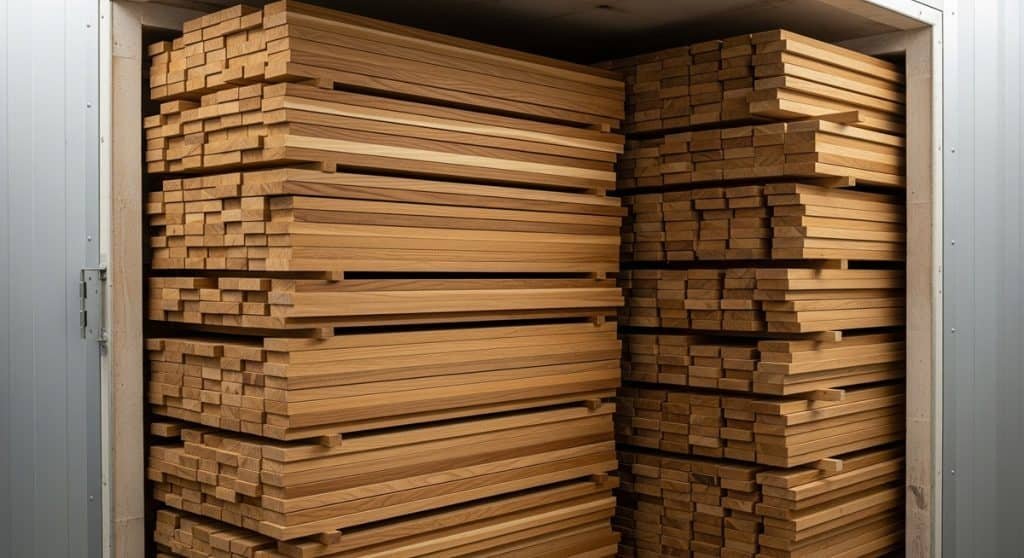
1. Introduction, Why Ulin?
Ulin is one of the most distinctive hardwoods found in Indonesia. Known for its exceptional density, durability, and resistance to demanding environments, it has traditionally been used for construction, bridges, marine work, and outdoor structures rather than furniture.
But what happens when ulin is used to manufacture furniture?
Our first ulin project (custom outdoor decking) gave us the opportunity to find out, not simply by working with pre-cut boards, but by selecting the logs and processing the material ourselves, from log to finished piece.
2. What Is Ulin?
Indonesian name: Ulin Also known as: Bornean ironwood, belian (Malaysia) Botanical name: Eusideroxylon zwageri (family Lauraceae)
Natural distribution: Native to Borneo and Sumatra, with populations also recorded in Bangka, Belitung, and the Sulu archipelago/Palawan region. It grows in lowland rainforest, typically as scattered individual trees rather than in dense stands.
Growth characteristics: Ulin is exceptionally slow-growing, commonly cited as taking well over a century to reach a harvestable diameter, and individual trees are long-lived. This slow growth, combined with historical over-harvesting, is why the species is currently listed as Vulnerable on the IUCN Red List.
For anyone specifying ulin, this is directly relevant: it reinforces why verified, legal sourcing isn’t optional, and why supply can be less predictable than for faster-growing commercial species.
Physical characteristics: Ulin is widely recognized as one of Indonesia’s most durable and exceptionally dense hardwoods. Reported basic density figures generally fall in the 900–1,200 kg/m³ range, meaningfully denser than commonly used furniture timbers such as teak. Its Janka hardness ratings, likewise, place it well above typical furniture species, consistent with its long history as a structural and marine timber rather than a furniture material.
Durability: Heartwood durability is rated very high, with documented service life of 50–100 years in ground contact and reports of 20+ years of performance in tropical marine conditions. It is also reported as resistant to termite attack.
Traditional applications: Heavy construction, bridges, marine and boatbuilding work, house piling, and roofing shingles, uses where the wood is expected to perform, untreated, in constant exposure to moisture and ground contact for decades.
3. Why Ulin Is Different to Work With
Most articles on ulin stop at “it’s durable and beautiful.” What’s less documented is what it’s actually like to process, and that’s where most of the difficulty (and the reason finished ulin furniture is rare) lies.
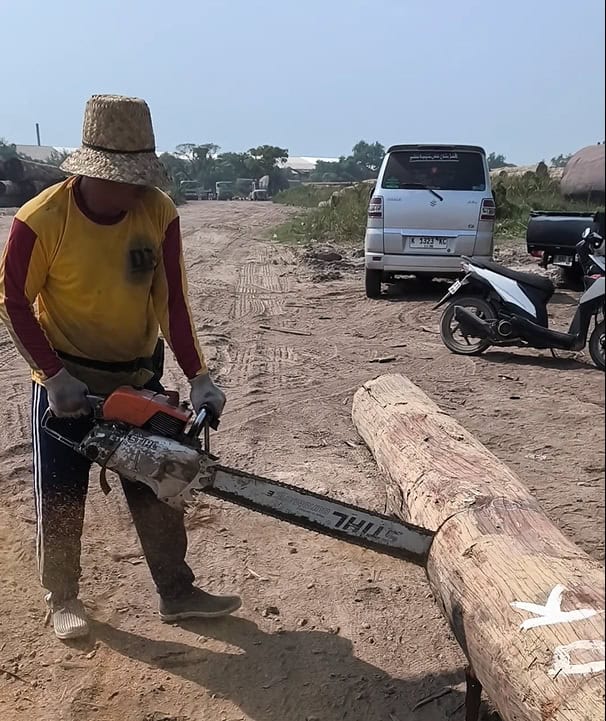
Log characteristics. Ulin isn’t sold the way furniture-grade teak or mahogany typically is. What we found wasn’t standardized furniture boards, it was large round logs, over 10 metres long and roughly 40cm in diameter, sold and selected much closer to a construction-timber transaction than a furniture-timber one.
Cutting the log. When we made our first cross-cuts into the log with a chainsaw, the timber immediately began to crack, releasing audible internal stress. This wasn’t a one-off, it happened at several points across multiple logs. For a workshop used to softer, more forgiving species, this was the first real signal that ulin needed to be approached differently from the ground up.
4. Sawing Ulin: Why the Cutting Strategy Matters
This is where the process becomes genuinely technical.
Round log
   ↓
Initial breakdown
   ↓
Cant (squared, rough-sawn block)
   ↓
Progressive sawing
   ↓
Furniture components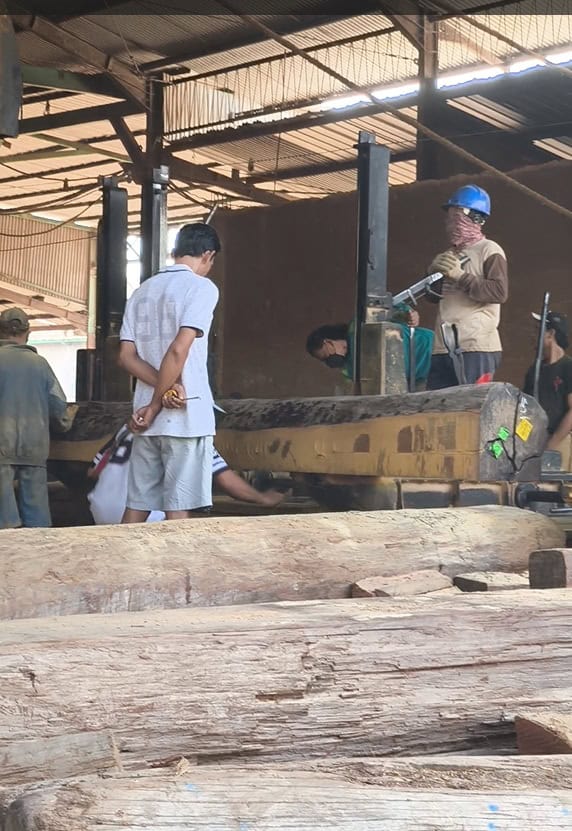
Our sawmill partners explained that directly opening an extremely dense ulin log into large, final-size boards can increase the risk of splitting. A more controlled breakdown process, progressively reducing the log into a cant before producing the required boards, can help manage the internal stresses released during sawing.
We saw this firsthand: when boards were split straight to final thickness, most of them cracked. Once the log was first roughed into a cant and only brought to final dimension in a later pass, the outcome was markedly more consistent. This approach naturally reduces recovery (usable timber per log) compared with straightforward sawing of a softer species, a cost factor worth understanding upfront rather than discovering mid-project.
5. From Raw Material to Furniture
Log selection → Cross-cutting → Sawmilling → Board selection →
Seasoning/drying → Machining → Joinery → Finishing → Furniture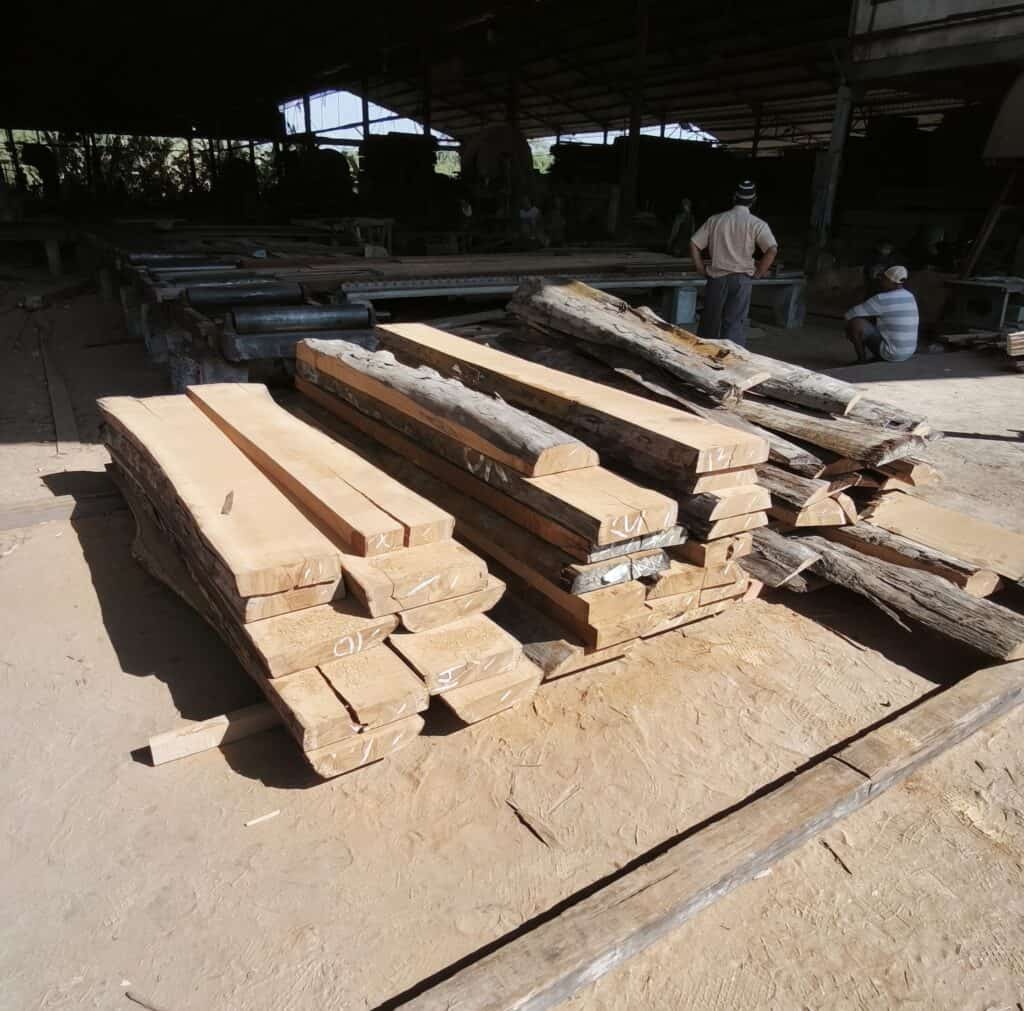
For a project manager evaluating a supplier, the question isn’t only “can you make a beautiful table?” It’s “can you actually execute a project using this material, end to end?” Having gone through log selection ourselves, rather than starting from a pre-cut board, is the part of this process most workshops working with ulin skip.
6. Ulin as a Furniture Material
Indoor furniture Dining tables · benches · coffee tables · consoles · sideboards · bed frames · architectural furniture pieces
Outdoor / semi-outdoor Outdoor tables · benches · poolside furniture · resort furniture · garden furniture
Hospitality & commercial projects Hotels · resorts · restaurants · villas · public spaces
Given its structural and marine heritage, ulin’s natural fit is in settings where furniture is exposed to humidity, heavy use, or simply needs to remain a fixed, permanent feature of a space rather than something rearranged over time.
7. Case Study — 2,500 × 1,000 mm Ulin Dining Table
| Specification | Detail |
|---|---|
| Material | Solid ulin |
| Table size | 2,500 × 1,000 mm |
| Component thickness | 60 mm |
| Component width | 150 mm |
| Seating | 2 matching benches |
| Material source | Selected ulin logs, processed in-house from log stage |
| Manufacturing | Custom-made |
Rather than reducing the material into a thinner, lighter construction, we deliberately retained substantial 60mm components to express the natural character and visual mass of ulin. The result is a piece built for spaces where furniture is meant to stay exactly where it’s placed.
8. What Project Managers Should Consider When Specifying Ulin
01 — Material availability. Ulin furniture is generally not something drawn from standard furniture-timber stock; sourcing needs to be planned for.
02 — Log selection. For large-format pieces in particular, starting from suitable logs, rather than pre-cut components of unknown origin, can materially affect the final result.
03 — Processing. Machining and sawing dense hardwood like ulin requires appropriate tooling, experience, and time; this is not a drop-in substitute process for softer species.
04 — Drying and moisture management. Large solid sections require careful, deliberate moisture management through the seasoning process.
05 — Dimensional movement. Like any solid timber, ulin still requires appropriate joinery and design allowances for natural movement over time.
06 — Lead time. Material procurement and preparation should be factored into project timelines from the outset, not treated as an afterthought.
07 — Specification. Dimensions, finish, edge treatment, joinery, and installation requirements should be discussed early in the design process.
9. Why Use Ulin?
| Characteristic | Ulin |
|---|---|
| Durability | Exceptional |
| Density | Very high |
| Natural appearance | Distinctive |
| Outdoor suitability | Excellent |
| Machining | More demanding |
| Availability | More limited |
| Large-format furniture | Possible with proper planning |
| Cost | Typically higher than common furniture timbers |
10. Closing — From Timber to Furniture
Working with ulin has reminded us that exceptional materials require a different approach. The process begins long before a piece of furniture enters the workshop, with selecting the right log, understanding how the timber responds during sawing, allowing the material to be prepared properly, and designing around its characteristics rather than against them.
For us, ulin is not simply another timber species. It’s a material with its own set of opportunities and manufacturing challenges, and with the right planning and craftsmanship, those characteristics can be translated into furniture designed for residential, hospitality, commercial, and architectural projects.
We work with architects, designers, contractors, and project managers on custom solid-wood furniture projects. If your project requires ulin or other Indonesian hardwoods, get in touch to discuss material sourcing, design development, and production requirements.