In commercial architecture, minimalism is the most unforgiving design language. Without moldings, decorative trim, or heavy ornamentation to conceal manufacturing discrepancies, structural integrity is the aesthetic.
When architects specify a minimalist statement piece furniture—such as a monolithic three-meter reception console or a suspended executive credenza—it serves as the visual and functional anchor of the room. In high-traffic environments like boutique hotel lobbies or corporate headquarters, these pieces cannot rely on cosmetic tricks. They must project absolute architectural authority.
At Naramulya, we approach modern minimalism not as a stylistic trend, but as a rigid set of dimensional and material standards. This technical guide outlines how our commercial-scale facility engineers massive, unadorned statement pieces that maintain absolute structural stability.
1. The Geometry of Exposure: Zero-Tolerance Joinery
In traditional furniture, a poorly fitted joint can be hidden behind a decorative trim. In minimalist design, a joint is fully exposed. A gap of even a single millimeter destroys the geometric purity of the piece and creates a weak point susceptible to kinetic failure.
The Naramulya Execution: We eliminate machining discrepancies by calibrating our industrial CNC routers to execute cuts within micro-tolerances of 0.15mm to 0.20mm. To construct the sharp, 90-degree angles characteristic of minimalist casegoods without exposing end-grain or relying on visible fasteners, we utilize precision-routed miter joints reinforced with internal splines or concealed domino tenons. These interlocking internal cavities are permanently flooded with structural 2-part epoxy, creating a monolithic, gap-free union that will not separate under dynamic loads.
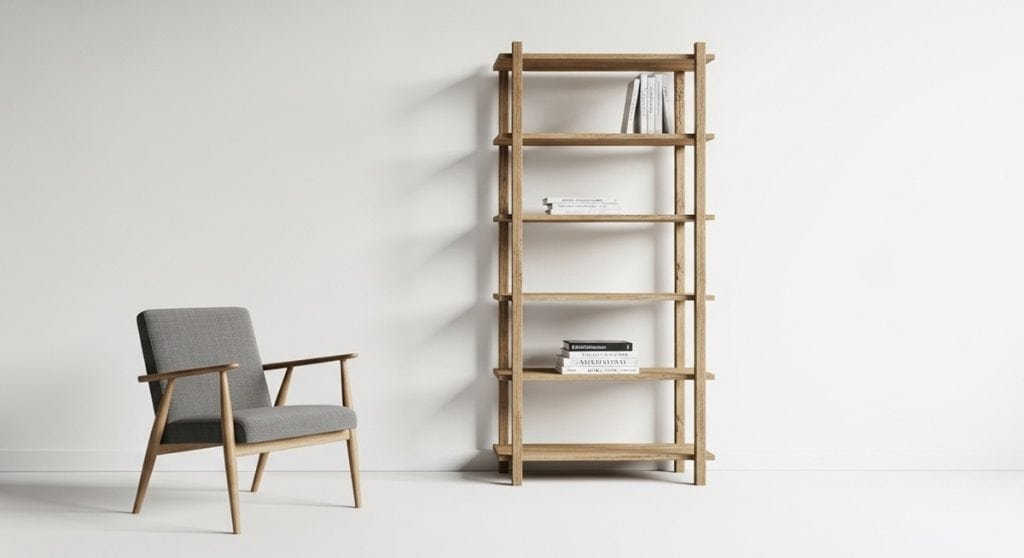
Example 1: The Architectural Bookcase. A geometric bookcase can serve as a “functional sculpture.” Its clean lines and solid form make it a perfect minimalist focal point, providing essential storage while also acting as an architectural element within the room.
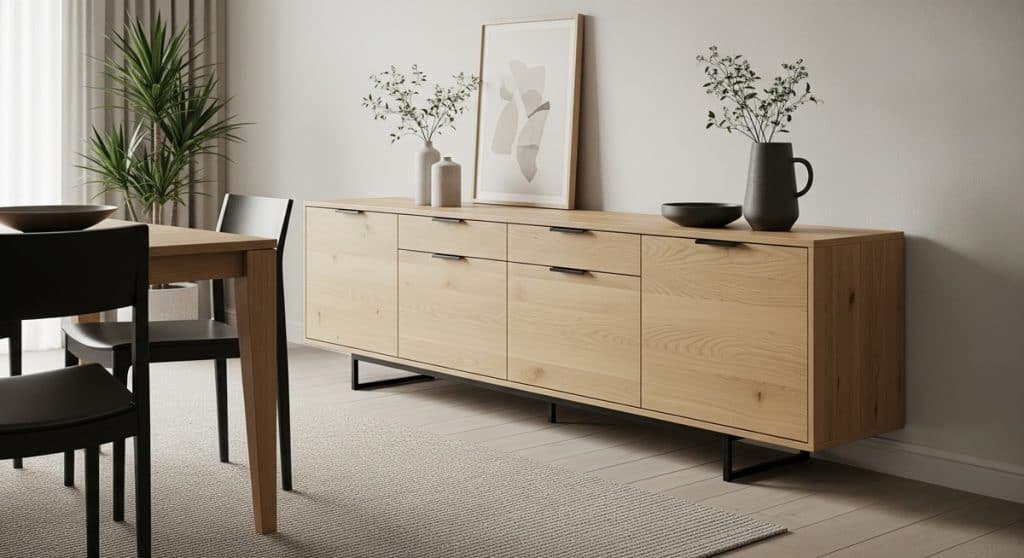
Example 2: The Substantial Sideboard. A long, low sideboard with a strong horizontal form can anchor a living or dining room. When designed with minimalist hardware and a focus on the natural wood grain, it becomes a powerful statement of substance and quality.
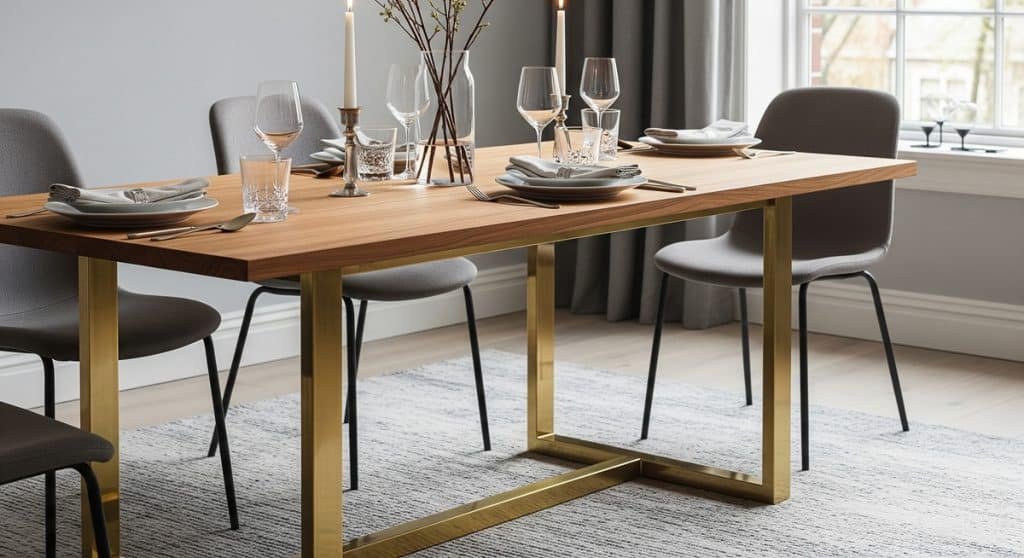
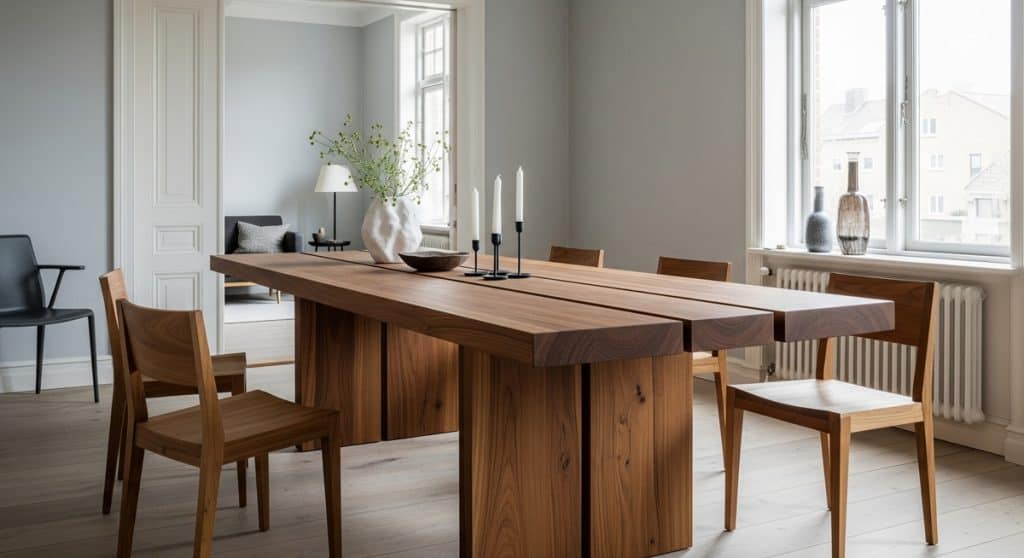
Example 3: The Sculptural Dining Table. In a minimalist dining room, the table is everything. A table with a simple but powerful geometry—built from thick, solid planks of teak—makes a definitive statement of function and form. It becomes the undisputed heart of the room and the ultimate statement piece furniture.
2. Volumetric Stability for Monolithic Planes
A hallmark of minimalist statement furniture is the use of large, uninterrupted, flat wooden planes. However, wood is an anisotropic material; it naturally wants to warp, cup, or twist across wide surface areas as ambient humidity fluctuates.
The Naramulya Execution: Attempting to build a massive, flat plane out of improperly dried timber will result in catastrophic failure within months of commercial deployment. We mitigate this risk through two strict engineering protocols:
- Strategic Plank Matching: We do not glue random boards together. Our engineers analyze the end-grain of the Tectona Grandis (Indonesian Teak) planks, alternating the growth ring orientations (cupping directions) across the span of the panel. This forces the boards to counteract each other’s natural movement, keeping the overall plane perfectly flat.
- Thermodynamic Equalization: As with all structural timber in our facility, the wood is subjected to our rigorous thermodynamic kiln-drying protocol, forcing the core to a stabilized 8–12% Equilibrium Moisture Content (EMC). This locks the cells, ensuring the monolithic plane remains dimensionally inert.
Inspirational Mood Board:
3. Material Transparency and the Zero-Filler Mandate
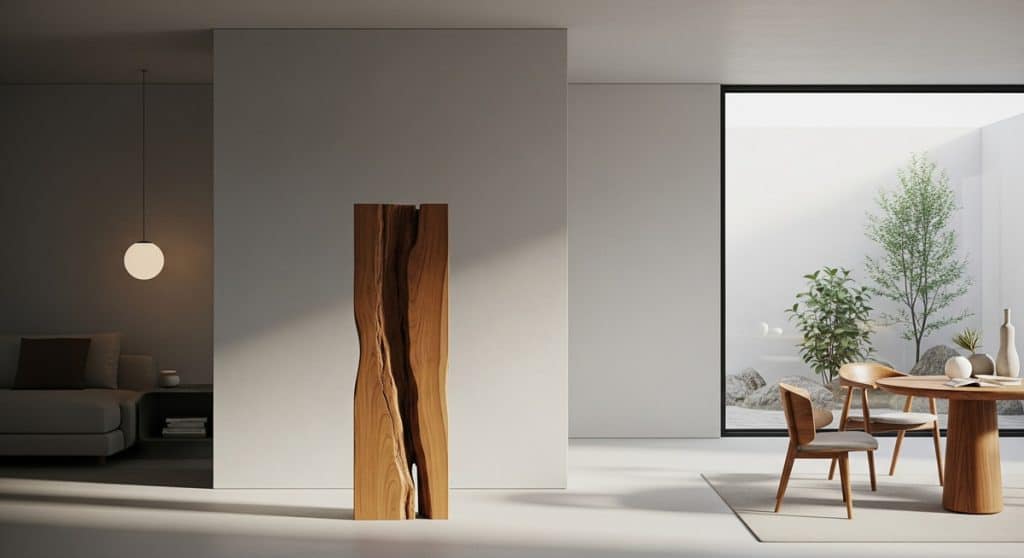
When form is reduced to its absolute minimum, the material itself must carry the design. In a minimalist teak statement piece, the grain is the only “pattern” in the room.
The Naramulya Execution: Standard mass-production factories frequently use lower-grade timber and fill the inevitable knots and cracks with synthetic, colored wood putty. In a minimalist piece, these patches are glaringly obvious and highly unprofessional.
We enforce a strict zero-filler policy for minimalist architectural pieces. We exclusively specify Grade A heartwood from Perhutani plantations, guaranteeing an exceptionally tight, straight grain pattern and uniform color. The wood you see is the dense, oil-rich material supporting the load. For deeper context on our substrate selection, review our B2B Material Science Comparison.
4. Concealed Mechanics and Deflection Control
Many minimalist designs feature “floating” components—such as wall-mounted media consoles or deeply cantilevered desks—that must support heavy dynamic loads without visible support legs.
The Naramulya Execution: Deflection (sagging) is the enemy of sharp geometric lines. To achieve these floating elements, we engineer concealed mechanics into the timber. For wall-mounted casegoods, we integrate heavy-duty, commercial-grade French cleats directly into the reinforced back panel of the unit, distributing the weight across the structural studs of the building rather than relying on weak drywall anchors. For long, unsupported spans, we route channels into the underside of the teak and inlay rigid steel torsion bars, guaranteeing the wood will not deflect under the weight of commercial equipment or hospitality displays.
Conclusion: Executing the Minimalist Statement
Modern minimalism is not about having “less”; it is about executing perfection on a highly exposed scale.
A successful minimalist statement piece furniture requires an uncompromising manufacturer who understands that simplicity is the ultimate engineering challenge. If your architectural project demands flawless geometric execution across various commercial teak furniture styles, strict material transparency, and concealed structural rigidity, submit your CAD specifications to the Naramulya technical team.