In commercial architecture, high-traffic hospitality procurement, and large-scale residential developments, substrate selection is a critical risk-mitigation calculation. The ongoing debate between teak wood vs engineered wood is frequently misunderstood by inexperienced specifiers as a simple budget decision. In reality, it is a choice between long-term structural integrity and guaranteed, mathematically predictable operational failure.
Engineered substrates—such as Medium Density Fiberboard (MDF), High-Density Fiberboard (HDF), particleboard, and veneered plywood—offer the illusion of efficiency through lower initial Capital Expenditure (CapEx). However, when subjected to the dynamic loads, aggressive cleaning protocols, and shifting humidity intrinsic to commercial environments, these composites suffer catastrophic failure rates.
This comprehensive technical guide breaks down the material science behind solid Tectona Grandis (Indonesian Teak) versus synthetic composite substrates, detailing why solid wood remains the only mathematically sound and structurally viable specification for commercial durability.
1. The Physics of Kinetic Failure and Fastener Tear-Out
Casework, credenzas, and seating in hotel rooms and F&B (Food & Beverage) environments are subjected to relentless kinetic stress. The primary failure point of any commercial cabinet is not the surface, but the hardware anchor—specifically, the localized zones where a heavy-duty hinge, drawer slide, or structural bracket connects to the substrate.
Composite boards are fundamentally flawed under dynamic tension. They consist of short, randomized wood fibers or chips bonded together with synthetic urea-formaldehyde resins under heat and pressure. They completely lack a continuous, interlocking grain structure. When a commercial-grade, 100,000-cycle European concealed steel hinge is anchored into MDF, the kinetic load of a heavy door opening and closing isolates extreme shear stress directly onto the screw threads.
Within 12 to 18 months of commercial utility, the short fibers surrounding the screw begin to disintegrate. The boreholes elongate, the resin matrix shatters, and the hinge literally tears out of the substrate. Because there is no grain to re-drill or re-thread securely, the piece is rendered entirely useless.
Solid teak, by contrast, possesses a dense, continuous long-grain fiber matrix bound by incredibly strong natural lignins. It acts as an immovable, high-tensile anchor for heavy-duty hardware. Furthermore, at Naramulya, our facility refuses to rely on metal fasteners for primary structural framing. We distribute dynamic loads across massive internal surface areas utilizing advanced wood-to-wood Javanese joinery (such as the deep Mortise & Tenon), permanently locked with industrial 2-part epoxy or Polyurethane (PU) adhesives. This engineering ensures the kinetic load is absorbed by the entire frame, not an isolated screw.
2. Hygroscopic Dynamics and Edge Delamination
Commercial furniture faces aggressive moisture threats daily. These range from spilled beverages and wet luggage to the highly alkaline cleaning solutions used by housekeeping staff, all compounded by the fluctuating humidity of commercial HVAC (Heating, Ventilation, and Air Conditioning) systems.
Engineered wood relies entirely on a fragile, millimeter-thin surface veneer or melamine laminate to protect its highly absorbent, hygroscopic core. In high-traffic commercial use, impact damage to the edge-banding is a statistical certainty—whether from a vacuum cleaner strike or a dropped suitcase. Once this 1mm protective barrier is compromised, the exposed MDF or particleboard core acts like a rigid sponge.
Through rapid capillary action, the core absorbs ambient moisture and cleaning fluids. This triggers irreversible volumetric swelling. The wood fibers expand, the resin bonds fail, the surface laminate bubbles, and total delamination occurs. This process is terminal and cannot be reversed or repaired.
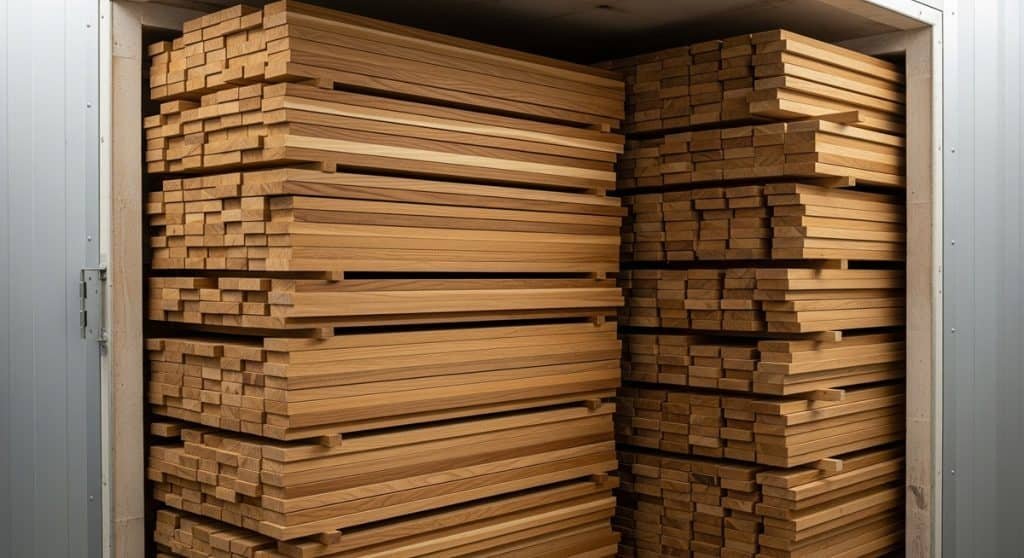
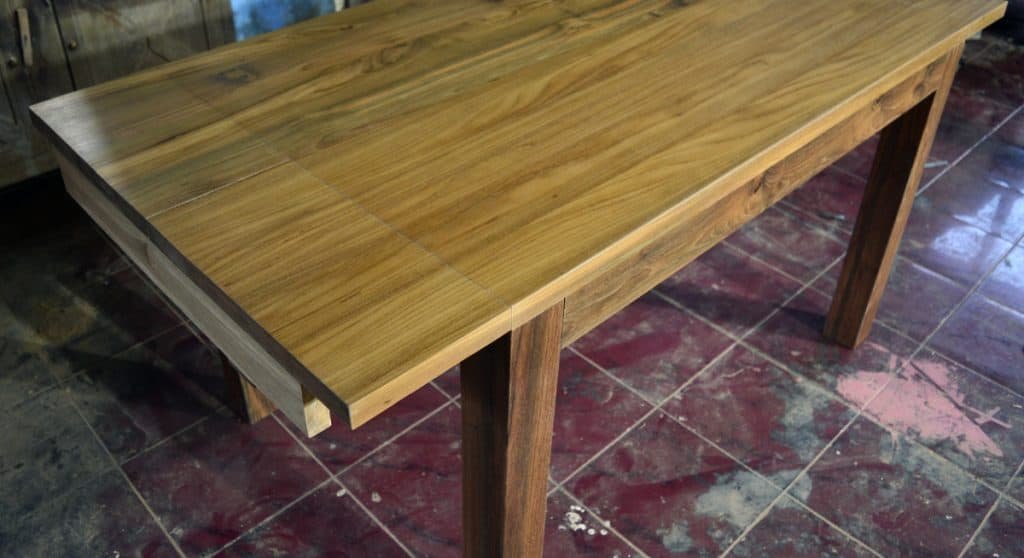
Solid teak is biologically engineered by nature to repel moisture. High concentrations of internal silica and natural tectoquinones (wood oils) create an active hydrophobic barrier deep within the cellular structure. Even if a teak dining table suffers a deep surface gouge from a knife, there is no vulnerable, absorbent core to expose. The material remains dimensionally stable and impervious to liquid penetration. To further guarantee this stability, Naramulya subjects all timber to a rigorous thermodynamic kiln-drying protocol, permanently stabilizing the wood core to a strict 8–12% Equilibrium Moisture Content (EMC).
3. Repairability: The OpEx Advantage of Solid Substrates
The financial viability of commercial furniture must be calculated over a 10-year Total Cost of Ownership (TCO) model. In this model, repairability is a massive financial asset.
When an engineered wood credenza sustains a deep scratch or edge chip, it is a total loss. You cannot sand through a 0.5mm synthetic laminate, and you cannot easily patch swollen, degraded MDF fiber. The entire unit must be uninstalled, discarded in a landfill, and replaced, incurring massive replacement costs and un-rentable room downtime.
Solid teak is a homogeneous substrate. The material on the surface is the exact same material at the core. When a solid teak desk or luggage rack is heavily scratched or dented by guests, it does not require replacement. On-site maintenance staff can locally remediate the damage by sanding the affected area with graded abrasives and spot-applying a penetrating oil or localized lacquer touch-up. This inherent repairability aggressively lowers your long-term Operational Expenditure (OpEx) and effectively extends the product’s lifespan indefinitely.
4. Machining Tolerances, Tooling, and CNC Precision
For architects specifying custom millwork, bespoke hotel collections, or highly intricate Japandi-style minimalism, precision execution is non-negotiable.
Composite substrates are notoriously difficult to machine cleanly at a commercial scale. Routing complex profiles, sharp architectural reveals, or deep channels in particleboard often results in “blowout” or chipping of the core material. This forces standard, low-tier factories to utilize thick, unsightly synthetic edge-banding to mask the messy, crumbling cuts.
High-grade plantation teak, due to its exceptional density, allows for aggressive, high-precision machining. Because we use strictly graded Tectona Grandis, Naramulya engineers can calibrate our heavy-duty CNC router spindles to exacting micro-tolerances of 0.15mm to 0.20mm. This allows us to execute flawless architectural lines, razor-sharp reveals, and zero-gap friction-fit joinery. We enforce a strict zero-filler policy; our precise machining eliminates the need for cosmetic putties or fillers to hide production discrepancies.
5. Chemical Off-Gassing, IAQ, and Verifiable ESG Compliance
Modern commercial developments, corporate headquarters, and high-end resorts must adhere strictly to Environmental, Social, and Governance (ESG) guidelines. A critical component of green building certifications like LEED or BREEAM is Indoor Air Quality (IAQ).
The manufacturing process of engineered woods relies heavily on urea-formaldehyde (UF) and phenol-formaldehyde (PF) adhesives to bind the wood chips together. Over time, particularly in warm or humid environments, these synthetic binders undergo hydrolysis. This process actively off-gasses carcinogenic Volatile Organic Compounds (VOCs) into the interior environment for years, degrading air quality and frequently violating commercial health and safety codes.
Solid teak is an organic, zero-VOC substrate that requires no toxic chemical binders for its structural integrity. Furthermore, at Naramulya, our material procurement is rigidly documented to ensure ethical sustainability. We strictly utilize legally harvested timber verified through the Indonesian government’s SVLK (Sistem Verifikasi Legalitas Kayu) chain-of-custody audit. Specifying Naramulya teak guarantees 100% traceability from the forest floor to the final installation, seamlessly satisfying your project’s strictest global environmental mandates.
6. Technical Comparison Matrix
| Engineering Metric | Solid Tectona Grandis (Teak) | Composite Substrates (MDF/HDF/Plywood) |
|---|---|---|
| Kinetic Fastener Anchor | High Tensile / Continuous long-grain | Low / Short-fiber resin matrix (Tear-out risk) |
| Hygroscopic Dynamics | Hydrophobic (Silica & Tectoquinones) | Highly Absorbent (Core swelling & delamination) |
| Machining Tolerance | 0.15mm – 0.20mm (Zero-filler execution) | Low (Prone to core blowout & chipping) |
| Repairability (OpEx) | High (On-site localized remediation) | Zero (Requires complete unit replacement) |
| Chemical Off-Gassing (IAQ) | Zero VOC (Organic substrate) | High (Urea-Formaldehyde hydrolysis) |
| Commercial Lifecycle | Decades (Mathematically sound ROI) | 18 – 36 Months (Guaranteed failure) |
Conclusion: CapEx Savings vs. OpEx Disaster
Specifying engineered composites for high-traffic hospitality or demanding B2B environments guarantees premature, catastrophic failure. The minor upfront CapEx savings achieved by purchasing MDF or plywood furniture are rapidly and aggressively destroyed by the compounding Operational Expenditure (OpEx) of maintenance labor, continuous replacement cycles, and the revenue lost to out-of-order rooms.
When the engineering data, chemical stability, and lifecycle economics are objectively reviewed in the teak wood vs engineered wood matchup, solid Tectona Grandis provides the only mathematically sound return on investment. It is not merely a luxury aesthetic; it is the uncompromising baseline requirement for true commercial fabrication.